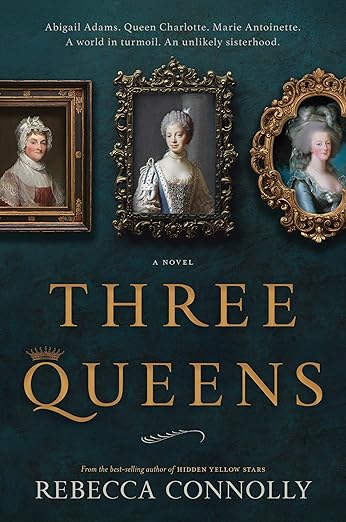
 THREE QUEENS, by Rebecca Connolly, Shadow Mountain, May 5, 2026, Hardcover, $28.99 (young adult/ new adult/ adult fiction)
Three Queens, by Rebecca Connolly, follows Abigail Adams, Queen Charlotte and Marie Antoinette as they navigate revolutions, royal pressures, and personal losses.
After the end of the American Revolutionary War, Abigail Adams crosses the Atlantic to reunite with her husband, John, after five long years apart. But she is unprepared for the glittering courts of England and France that are so different from her experience in the newly established United States. Undeterred, Abigail sets her sights on forging bonds with the queens of Europe, believing their support is key to her nation’s future.
In England, Queen Charlotte carries the weight of an empire on her shoulders. Her husband, King George III, battles a private madness, while political tensions rise and her eldest son schemes for power. Charlotte struggles to maintain order and propriety—while clinging to the solace she finds in her correspondence with her friend Marie Antoinette in France.
Revolution has gripped France, and Marie Antoinette must watch as her world crumbles. Vilified by the public and neglected by a king who refuses to see the storm coming, she faces growing unrest with dwindling allies. As tragedy strikes her family, she reaches out to her friends—Charlotte and Abigail—in a last attempt to find a path forward, possibly even escape.
The paths of these three women cross in unexpected ways in public, in private, and through letters. They forge a quiet sisterhood across borders and upheaval, each one facing love and loss, sweetness and strife, revolution and regrets. —Synopsis provided by Shadow Mountain
Rebecca Connolly (Hidden Yellow Stars, Under the Cover of Mercy) is no stranger to historical fiction, and in Three Queens, she takes on some of the biggest names from the late 18th and early 19th centuries.
In Three Queens, Connolly imagines found friendships among Abigail Adams, Queen Charlotte of England and Marie Antoinette of France. These friendships unfold through correspondence and a few personal meetings. While fiction, Connolly does note that Abigail did meet both queens and the queens may have corresponded. Connolly also pulled from historical records and Abigail’s known writings.
The premise is strong, particularly the contrast between societal expectations.
The problem with a book like Three Queens is making all the women compelling enough to want to keep reading. It’s natural to connect more with one or two of them and not the third. Because while there are numerous similarities — sense of duty, public perception, burdens — their situations were very different.
While Connolly’s approach is commendable, the book feels very insular. There’s a lot of long paragraphs with little to break it up. Connolly captures reactions and inner musings, a lot of explaining without a lot of actual action. This, unfortunately, limits the audience, making for a good rather than a great read.
Copyright © 2026 Cracking the Cover. Unless otherwise noted, all books — digital and physical — have been provided by publishers in exchange for honest and unbiased reviews. All thoughts and opinions are those of the reviewer.
